

The Undiscovered Country
The Undiscovered Country: Triumph, Tragedy, and the Shaping of the American West by Paul Andrew Hutton is a sweeping, meticulously researched chronicle that dismantles the myths surrounding America’s frontier era. Spanning from General Braddock’s 1755 defeat to the massacre at Wounded Knee in 1890, the book captures the complex, often contradictory forces that shaped the West. Hutton paints the landscape not as a stage for unbroken progress and conquest but as a terrain marked by ambition, cultural collision, and environmental degradation. In doing so, he challenges the romantic vision long embedded in America’s national identity, replacing it with a more nuanced story of human resilience, greed, sacrifice, and tragedy.
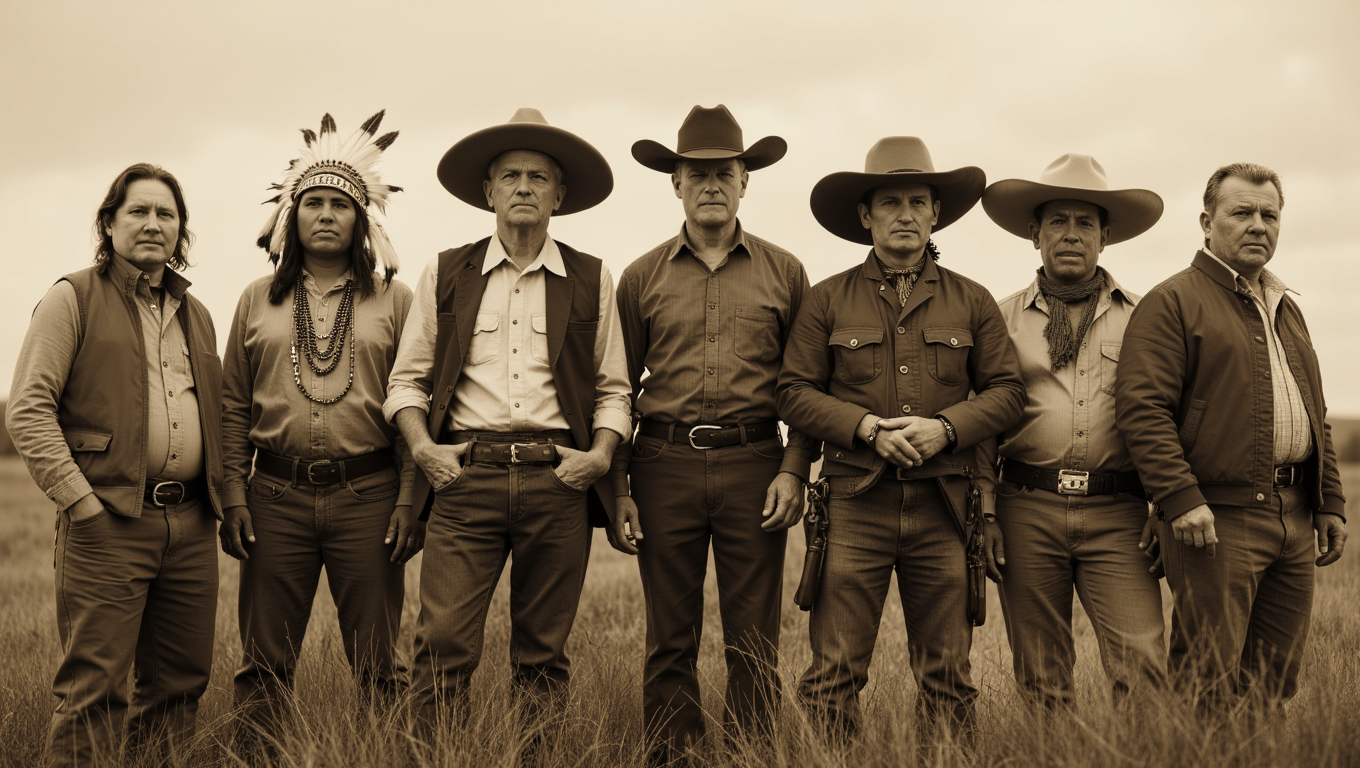
At the heart of Hutton’s narrative are seven key figures whose lives embody the epoch’s breadth and contradictions: Daniel Boone, Red Eagle (William Weatherford), Davy Crockett, Mangas Coloradas, Kit Carson, Sitting Bull, and William “Buffalo Bill” Cody. By intertwining their biographies, Hutton constructs a multigenerational tapestry that blends heroism with brutality. Boone and Crockett represent the enduring allure of the white frontiersman, while Sitting Bull and Mangas Coloradas highlight Indigenous resistance and cultural endurance. Red Eagle and Buffalo Bill serve as symbolic bridges—each navigating complex intersections of identity, politics, and survival in a rapidly transforming world.
Geographically, The Undiscovered Country is as expansive as the history it tells. Hutton’s lens shifts from the dense forests of Pennsylvania and Kentucky to the high peaks of the California Sierras, across the harsh deserts of the Southwest, and into the sweeping buffalo ranges of the Great Plains. Each setting becomes more than a backdrop—it’s a character in its own right, shaped by and shaping human ambition. Alongside these vivid landscapes, Hutton examines the irreversible environmental toll of westward expansion, showing how railroads, mining, overhunting, and settlement transformed ecosystems and forever altered the lives of Indigenous peoples.
One of the book’s most striking contributions is its effort to place Indigenous voices and experiences alongside those of the white canon. While many histories have relegated Native American perspectives to the margins, Hutton works to give them equal footing in the grand narrative. Figures like Sitting Bull and Mangas Coloradas are portrayed not merely as obstacles to progress but as leaders with complex political strategies, spiritual depth, and a profound connection to the land. This balance is not without its critics—some argue that Hutton’s reliance on a “great man” biographical framework risks sidelining broader communal experiences—but it still marks a step toward a more inclusive frontier history.
Critics and reviewers have praised The Undiscovered Country for its accessible storytelling and scholarly rigor. Library Journal called it “timely” and “hard to put down,” while Kirkus Reviews highlighted its vivid portrayals and sympathy toward Indigenous figures. History enthusiasts appreciate its blend of dramatic narrative and factual depth, and casual readers find it approachable despite its scope. Hutton’s ability to weave cultural history, military campaigns, political movements, and environmental change into one cohesive volume makes the book a valuable addition to both academic and popular literature on the West.
Ultimately, Hutton’s work invites readers to reconsider the foundation myths of the American West. It is a reminder that the “undiscovered country” was never truly undiscovered—it was inhabited, cultivated, and defended long before settlers arrived. By stripping away romanticized notions of frontier glory, Hutton reveals a legacy both inspiring and sobering: inspiring in the human capacity for endurance and adaptation, sobering in the costs paid in blood, land, and heritage. For those seeking to understand the real story behind America’s most enduring creation myth, The Undiscovered Country is both an essential history and a powerful reckoning.
Review of The Undiscovered Country: Triumph, Tragedy, and the Shaping of the American West
Paul Andrew Hutton’s The Undiscovered Country is a masterful re-examination of the American West, cutting through layers of myth to reveal a history that is as complex as it is compelling. Spanning from Braddock’s 1755 defeat to the massacre at Wounded Knee in 1890, Hutton offers a sweeping narrative that refuses to romanticize conquest. Instead, he shows how ambition, violence, cultural collision, and environmental ruin together shaped a pivotal chapter in America’s identity.
The book’s strength lies in its structure around seven central figures—Daniel Boone, Red Eagle, Davy Crockett, Mangas Coloradas, Kit Carson, Sitting Bull, and Buffalo Bill Cody. Through their intertwined lives, Hutton captures both the heroic and tragic dimensions of the frontier. These biographies serve not just as personal stories but as prisms through which larger themes—Manifest Destiny, Indigenous resistance, and ecological transformation—are explored.
Hutton’s prose is vivid and cinematic, moving fluidly across forests, deserts, plains, and mountains, bringing both landscape and history to life. His balanced approach, giving Indigenous perspectives equal space alongside white frontiersmen, adds depth, even if his “great man” framework occasionally narrows the scope.
Critics have rightly praised the book for its readability and scholarly rigor, making it accessible to both seasoned history readers and newcomers. It is at once a celebration of human resilience and a sobering account of the costs of expansion.
The Undiscovered Country is essential reading for anyone seeking to understand the truth behind America’s most enduring creation myth—and the human and environmental price it exacted.
